9. Maintenance
🔧 Tools Required
• Torque wrench (0-100 Nm range)
• Socket set (M12 hex nuts)
• M10 ring bolt (for basket extraction)
• Soft brushes (no metal bristles on PTFE)
• Cleaning materials (lint-free cloth, approved solvent)
• Digital caliper (gap measurement)
• Pliers (for round cord installation)
• Grease (approved for PFA contact)
📋 Recommended Spare Parts
• Complete strainer basket assembly (size-specific: DN 25, 40, 50, 80, 100)
• PTFE sealing discs (top and bottom covers - 2 required)
• Round cord seal (PTFE)
• Cover fasteners, size- and cover-specific per Section 1.5.2 (studs DIN 938, cylinder-head screws ISO 4762, hex screws DIN 933 — all M12, A4-70)
• Hex nuts and washers per fastener size
• ETFE filter mesh (specify mesh size: 85-2000µm)
- All maintenance work must be performed by qualified personnel
- Use only original spare parts
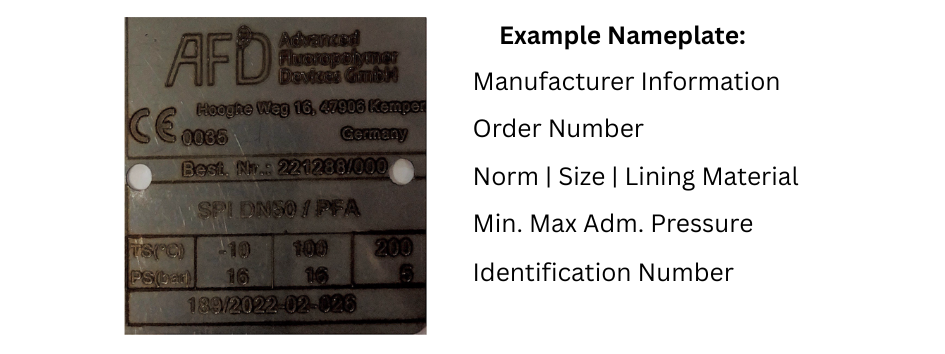
https://gft9.shop/pages/spare-parts-overview - Refer to valve identification data when ordering parts
- Observe all safety requirements (Section 7.3 - depressurize, isolate, drain)
9.1 Regular Inspection Schedule
Daily / Before Operation:
• Visual check for external leaks (covers, flanges)
• Check flush valve operation (if equipped)
• Verify no coating damage or rust spots
Weekly:
• Monitor differential pressure (if gauge equipped)
• Visual inspection of exterior condition
• Check cover bolt tightness (hand-check for looseness)
Monthly:
• Function test flush valve (if equipped)
• Verify flow direction arrow visible
• Check for process fluid staining (potential leak indicator)
Quarterly:
• Torque check on cover bolts (per Section 1.5.2 — cross pattern)
• Body coating inspection (touch up if needed)
• Basket inspection (may require removal for visual check)
Semi-Annual:
• Remove and clean strainer basket (per application requirements)
• Inspect ETFE mesh for tears or excessive debris
• Check PTFE seals for compression set
Annual / After Heavy Use:
• Full strainer inspection (remove both covers)
• Replace PTFE seals (top and bottom)
• Inspect body interior PFA lining for damage
• Pressure test strainer (verify no leaks)
9.2 Strainer Basket Removal
When Required:
• Clogged basket (high differential pressure)
• Scheduled cleaning interval
• Mesh inspection or replacement
• Round cord seal replacement
⚠ IMPORTANT: System must be fully depressurized and drained before opening
Procedure:
Step 1: Isolate and Prepare
• Close upstream and downstream isolation valves
• Depressurize system completely (verify with gauge)
• Drain residual fluid using bottom flush valve (if equipped)
• Apply lockout/tagout per company procedures
Step 2: Remove Top Cover
• Loosen the top cover nuts (number per size: see Section 1.5.2) in cross pattern (gradual loosening)
• Remove nuts and washers (place in clean container)
• Lift top cover vertically off body
• Set cover aside on clean surface
Step 3: Extract Strainer Basket
• Thread M10 ring bolt into central hole on basket top
• Pull basket vertically upward out of body
• ⚠ CAUTION: Residual fluid may drain from basket - have drip tray ready
• If basket sticks: Remove basket support and push from below (Section 8, Problem 2)
Step 4: Inspection Before Cleaning
• Check seal ring condition during removal
• Note debris type and quantity (for maintenance records)
• Inspect anti-rotation knob for damage
• Take photos if unusual wear patterns observed
9.3 Strainer Basket Cleaning
When Required:
• After removal per Section 9.2
• Visible debris accumulation
• High differential pressure indication
Cleaning Procedure:
Step 1: Initial Debris Removal
• Shake out loose debris into appropriate waste container
• If flush valve equipped: Basket can be flushed before removal
• Dispose of debris per process fluid safety guidelines
Step 2: Filter Mesh Cleaning
• Use soft brush to remove debris from ETFE mesh
• Brush from inside to outside (pushes debris out of mesh)
• Avoid metal brushes or abrasive pads (will damage PTFE components)
Step 3: Solvent Cleaning (if required)
• Use approved cleaning solution compatible with process fluid
• Soak basket in cleaning solution if heavily contaminated
• Ultrasonic cleaning permissible (if equipment available)
• Rinse thoroughly with clean solvent or DI water
Step 4: Drying
• Air dry completely before reinstallation
• May use compressed air (low pressure) to accelerate drying
• Inspect for cleanliness using backlighting (hold mesh to light)
Step 5: Post-Cleaning Inspection
• Inspect ETFE mesh for tears, holes, or separation
• ✓ PASS CRITERIA: No visible damage, mesh intact, no embedded debris
• If mesh damaged: Replace the filter mesh (Section 9.5)
• If round cord damaged: Replace per Section 9.7
⚠ WARNING: Do not use abrasive cleaners, metal brushes, or high-pressure steam
9.4 Strainer Basket Installation
When Required:
• After cleaning per Section 9.3
• After mesh or seal replacement
• New basket installation
Procedure:
Step 1: Pre-Installation Inspection
• Verify basket clean and dry
• Verify ETFE mesh intact (no tears)
• Verify round cord seal present and properly seated
• Clean body interior if debris present
Step 2: Position Indicator Alignment
• Locate white position indicator knob on basket bottom
• Locate corresponding slot in body interior (PFA-lined cavity)
• ⚠ CRITICAL: Knob MUST align with slot for proper installation
Step 3: Basket Insertion
• Hold basket by top rim
• Align white knob with body slot
• Lower basket vertically into body
• Push down gently until basket seats on bottom seal surface
Step 4: Verify Installation
• Basket should sit flat (no tilting)
• Top rim of basket should be even with body top flange
• Test anti-rotation: Attempt to rotate basket slightly
• ✓ PASS: Basket resists rotation (knob engaged in slot)
• ✗ FAIL: Basket rotates freely - remove and re-align
Step 5: Top Cover Reinstallation
• Position PTFE sealing disc in top cover recess (verify centered)
• Lower top cover onto body (align with studs)
• ⚠ CAUTION: Do not drop cover (protects PFA lining)
• Install washers and nuts (hand-tight initially)
Step 6: Top Cover Torquing
• Torque pattern — 4 bolts: 1→3→2→4; 6 bolts: 1→4→2→5→3→6; 8 bolts: 1→5→3→7→2→6→4→8 (opposite bolt pairs; count per size see Section 1.5.2)
• First pass: approx. 35 Nm (all nuts)
• Second pass: 50 Nm FINAL (all nuts; see Section 1.5.2)
• Monitor gap around circumference during torquing
• Gap should be even (±0.5 mm variation maximum)
Step 7: Final Verification
• Measure gap at 4 locations: N, S, E, W
• Record measurements: _____ mm (all within ±0.5 mm)
• Verify no PTFE seal protrusion visible at joint
• Check flow direction arrow visible
9.5 Filter Mesh Replacement
When Required:
• ETFE mesh torn or damaged
• Mesh size change required for application
• Mesh degradation from temperature/chemical exposure
⚠ NOTE: Mesh replacement requires complete basket disassembly
Procedure:
Step 1: Basket Disassembly
• Remove strainer basket per Section 9.2
• Mark position of inner and outer tubes relative to round cord
• Pull round cord out of basket bottom groove (use pliers)
• Rotate and pull outer tube off inner tube assembly
Step 2: Remove Old Filter Mesh
• Unroll ETFE mesh from inner tube
• Note overlap direction for new mesh installation
• Inspect inner and outer tubes for damage
• Clean tubes if residue present
Step 3: Install New Filter Mesh
• Verify correct mesh size (85-2000µm as specified)
• Wrap ETFE mesh around inner tube
• Maintain overlap in same direction as original (typically 20-30mm)
• Ensure mesh covers full length of inner tube
Step 4: Reassemble Basket
• Slide outer tube over inner tube assembly
• ⚠ CRITICAL: Rotate WITH overlap direction (not against)
• Apply even pressure during sliding
• Insert tubes together into basket bottom
Step 5: Install Round Cord Seal
• Align tubes per original position markings
• Press round cord into basket bottom groove
• Cord should seat fully with no gaps or protrusions
• Leave approximately 10mm protruding for future removal
Step 6: Verify Assembly
• Check that mesh is secure between tubes
• Verify round cord seated properly
• Test-fit in body (verify anti-rotation engagement)
• Reinstall per Section 9.4
9.6 PTFE Seal Replacement (Top and Bottom Covers)
When Required:
• External leak at cover/body joint
• Annual preventive maintenance
• Seal compression set (permanent deformation)
• Visible damage to seal
Procedure:
Step 1: Cover Removal
• For top cover: Remove per Section 9.2
• For bottom cover: Remove the bottom cover screws (type and number per size: see Section 1.5.2) and take the cover off
Step 2: Remove Old PTFE Seal
• Lift seal out of cover recess
• Inspect seal for compression set (flattened areas)
• Note any unusual wear patterns for records
Step 3: Clean Seal Recess
• Remove any debris or residue from recess
• Wipe with lint-free cloth
• Verify recess not damaged or deformed
Step 4: Install New PTFE Seal
• Position new seal in cover recess
• Center seal concentrically (equal spacing all around)
• Press seal flat into recess (should sit flush)
• ⚠ CRITICAL: Seal must not protrude above cover surface
Step 5: Reinstall Cover
• For bottom cover: Verify inlet orientation correct
• Install per Section 9.4 (torque per Section 1.5.2)
• Verify gap even around circumference
Step 6: Pressure Test
• After reassembly, perform pressure test (per company procedures)
• Verify no leaks at reinstalled cover
• Check gap measurement (±0.5 mm)
9.7 Round Cord Seal Replacement
When Required:
• Internal bypass leakage (reduced filtration efficiency)
• Visible damage to cord during basket inspection
• Cord compression set or chemical degradation
Procedure:
Step 1: Basket Disassembly
• Remove and disassemble basket per Section 9.5, Step 1
• Pull old round cord out using pliers
• Inspect basket bottom groove for damage
Step 2: Clean Basket Bottom Groove
• Remove any residue from old cord
• Clean groove thoroughly with cloth
• Verify groove depth uniform (no damage)
Step 3: Install New Round Cord
• Obtain replacement cord (order correct diameter for size)
• Insert cord into basket bottom groove
• Press cord evenly into place using pliers
• Work around entire circumference
Step 4: Verify Installation
• Cord should seat fully in groove
• No gaps or voids around circumference
• Leave approximately 10mm protruding (aids future removal)
• Cord should not be stretched or compressed
Step 5: Reassemble Basket
• Reassemble per Section 9.5 (reverse order)
• Verify anti-rotation knob intact
• Reinstall basket per Section 9.4
9.8 Cover Bolt Maintenance
When Required:
• Semi-annual inspection
• After thermal cycling (first 24 hours of operation)
• If leaks detected at covers
• Thread damage suspected
Procedure:
Step 1: Visual Inspection
• Check all cover fasteners (number per size and cover: see Section 1.5.2)
• Inspect for corrosion, thread damage, or bending
• Check washers for deformation
Step 2: Torque Verification
• Use calibrated torque wrench
• Check each nut: target torque per Section 1.5.2
• Follow cross pattern — 4 bolts: 1→3→2→4; 6 bolts: 1→4→2→5→3→6; 8 bolts: 1→5→3→7→2→6→4→8
• If any nut loose: Re-torque all nuts in sequence
Step 3: Thread Maintenance
• If studs corroded: Remove and replace
• Clean threads with wire brush if dirty
• Apply grease to threads during reinstallation
• Verify nuts thread smoothly (no binding)
Step 4: Fastener Replacement
• If threads damaged: Replace stud/nut immediately
• Fasteners are size- and cover-specific, see Section 1.5.2 — e.g. DN 25: top studs DIN 938 M12×35, bottom cylinder-head screws ISO 4762 (DIN 912) M12×40/45, A4-70. Consult the manufacturer if in doubt.
• Use only stainless steel grade 316 (or better)
• Apply anti-seize to threads during installation
Step 5: Establish Torque Check Schedule
• After initial heat-up: 24 hours
• High vibration service: Monthly
• Normal service: Semi-annually
• Document torque checks in maintenance log
9.9 Pressure Testing After Maintenance
When Required:
• After any cover removal/reinstallation
• After PTFE seal replacement
• After basket replacement
• Annual verification
⚠ NOTE: Pressure testing recommended before returning to service
Procedure:
Step 1: Visual Inspection
• Verify all covers installed and torqued per Section 1.5.2
• Check no tools or parts left inside strainer
• Verify flow direction correct
Step 2: Low Pressure Test (Air or Water)
• Close downstream isolation valve
• Slowly pressurize to 2-3 bar
• Inspect all joints for leaks
• Listen for air leaks (if using compressed air)
Step 3: Full Pressure Test
• Gradually increase to operating pressure
• Hold pressure for 5 minutes minimum
• Inspect cover joints for leakage
• Check basket area (look for bypass around seal)
Step 4: Leak Detection
• If leak detected: Depressurize immediately
• Identify leak location (cover, seal, basket)
• Re-torque bolts or replace seals as needed
• Repeat pressure test after repair
Step 5: Documentation
• Record test pressure: _____ bar
• Test duration: _____ minutes
• Result: ✓ PASS / ✗ FAIL
• Technician signature: __________
• Date: __________
9.10 Maintenance Records
Recommended Documentation:
• Date of maintenance
• Work performed (basket cleaning, seal replacement, etc.)
• Parts replaced (include part numbers and serial numbers)
• Torque values applied
• Gap measurements (top and bottom covers)
• Pressure test results
• Unusual observations or issues
• Technician name
• Next scheduled maintenance date
Example Maintenance Log Entry:
Date: 2026-01-15
Work: Basket cleaning, top cover PTFE seal replacement
Parts: PTFE seal (P/N: GSO-SEAL-TOP-DN80)
Torque: 50 Nm (verified all 6 top cover nuts)
Gap: 1.2mm average (N:1.2, S:1.1, E:1.3, W:1.2)
Pressure Test: 16 bar × 5 min - PASS
Notes: ETFE mesh in good condition, no tears observed
Tech: [Name]
Next Service: 2026-07-15 (6 months)